Your Complete Guide to Down Payment Assistance Programs for First-Time Home Buyers in Ontario
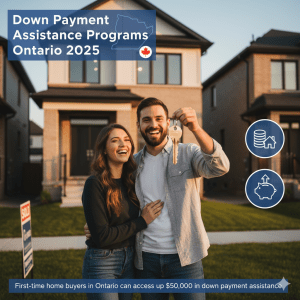
Breaking into the Ontario housing market as a first-time home buyer can feel overwhelming. With average home prices in the province exceeding $865,000 in 2024, and Toronto prices surpassing $1,000,000, saving for a down payment is one of the biggest hurdles aspiring homeowners face. However, what many Canadians don’t realize is that numerous government programs and municipal initiatives exist specifically to help you overcome this financial barrier.
This comprehensive guide will walk you through all the down payment assistance programs available across Ontario, from provincial tax rebates to city-specific forgivable loans. Whether you’re looking in London, Waterloo, Toronto, or smaller communities, there’s likely a program designed to help you achieve homeownership.
Understanding First-Time Home Buyer Status
Before diving into specific programs, it’s important to understand what “first-time home buyer” means in the context of government assistance. Generally, being a first-time home buyer means you have never owned a home, though there are exceptions for situations like separation or divorce, or if you previously received a home as a gift or inheritance rather than purchasing it.
For most programs, you’ll need to demonstrate that neither you nor your spouse has owned a home anywhere in the world while you were together. This definition ensures assistance goes to those who truly need help entering the housing market for the first time.

Provincial Programs Available Throughout Ontario
Ontario Land Transfer Tax Rebate
One of the most valuable provincial benefits available to first-time buyers is the Land Transfer Tax Rebate. Eligible first-time home buyers can receive a refund of the provincial land transfer tax, with buyers paying no tax for homes worth less than $368,000, and homes with higher values resulting in refunds of up to $4,000.
Eligibility Requirements:
- Must be at least 18 years old
- Canadian citizen or permanent resident of Canada
- Must live in the home as your principal residence within nine months of registering it in your name
- Cannot have previously owned a home or had interest in a home anywhere in the world
- Your spouse cannot have owned a home while they were your spouse
This rebate alone can save you thousands of dollars at closing, making it one of the most impactful programs for Ontario buyers. The land transfer tax typically ranges from 0.5% to 2.0% of the purchase price, so this rebate represents significant savings.
Toronto Municipal Land Transfer Tax Rebate
If you’re purchasing in Toronto, you face an additional municipal land transfer tax on top of the provincial one. The good news? First-time buyers in Toronto can avoid some or all of the municipal land transfer tax, with a maximum refund of $4,475. The requirements for the provincial rebate also apply to this municipal rebate, potentially saving Toronto buyers up to $8,475 in total when combined with the provincial rebate.
First-Time Home Buyers’ Tax Credit
The First-Time Home Buyers’ Tax Credit helps offset some of the upfront costs of purchasing a home, such as legal fees, home inspections, and closing costs. Eligible buyers can claim up to $10,000 on their tax return for a qualifying home, resulting in a tax reduction of up to $1,500 (15% of the claim amount).
While this won’t help with your initial down payment, it can help recoup some of the substantial closing costs associated with home buying, including legal fees, home inspections, title insurance, and appraisal fees.
Federal Programs Supporting Home Buyers
First Home Savings Account (FHSA)
The FHSA is a powerful new savings tool introduced by the federal government. This account allows you to save up to $40,000 tax-free, with annual contributions capped at $8,000. What makes this particularly attractive is that contributions are tax-deductible (like an RRSP) and withdrawals for your first home are tax-free (like a TFSA), giving you the best of both worlds.
Home Buyers’ Plan (HBP)
Under the RRSP Home Buyers’ Plan, first-time home buyers can withdraw up to $60,000 from their RRSP to put toward a home purchase. This withdrawal is interest-free and tax-free, though you must repay it to your RRSP over 15 years. This can be an excellent option if you’ve been contributing to your RRSP and have accumulated sufficient funds.
Extended Amortization Period
As of December 15, 2024, first-time home buyers have the option to extend their amortization to 30 years, instead of the standard 25 years. While this increases the total interest paid over the life of the mortgage, it significantly reduces monthly payments, making homeownership more affordable in the short term.
Important Note: The First Time Home Buyer Incentive offered through the federal government was discontinued as of March 31, 2024. This program previously offered interest-free loans of 5% to 10% of a home’s purchase price, but is no longer available to new applicants.
City of London Down Payment Assistance Program
For buyers in London and Middlesex County, there’s excellent news. The program provides interest-free, forgivable loans covering up to 5% of a home’s purchase price (up to $25,000) for eligible buyers, with the loan fully forgiven after 20 years when program conditions are met.
This partnership between the Government of Canada, the Province of Ontario, and the City of London through the Ontario Priorities Housing Initiative specifically assists moderate-income renters in making the transition from renting to homeownership. The loan is registered as a second mortgage on your property, and as long as you don’t sell within 20 years, you’ll never have to repay it.
Key Features:
- Up to 5% of purchase price
- Maximum loan amount: $25,000
- Interest-free
- Forgivable after 20 years
- First-come, first-served basis
- Targeted at current renters
This program represents a significant opportunity for London-area residents to bridge the down payment gap and achieve stable, permanent housing.
Region of Waterloo Affordable Home Ownership Program
The Waterloo Region offers one of the more generous programs in Ontario. Eligible first-time home buyers with a household income of up to $109,000 can receive a 5% loan when purchasing a home for $600,000 or less in the Waterloo Region.
Eligibility Requirements:
- Must be at least 18 years old and currently renting
- Have resided in Waterloo Region for at least the last year
- Household income up to $109,000
- Purchasing a home for $600,000 or less
- Must obtain mortgage pre-approval from a lender
The loan is interest-free and provided as a 20-year forgivable loan. If you remain in the home for 20 years without selling, the loan is completely forgiven. If you sell before 20 years, you must repay 5% of the sale price plus 5% of any capital gain realized.
To apply, you need to complete the Affordable Home Ownership application form and submit it with required documentation including proof of residency, income verification, mortgage pre-approval, and identification. Applications can be submitted by mail, fax, email, or in person at Regional offices in Kitchener, Cambridge, or Waterloo.
Simcoe County Affordable Homeownership Program
Simcoe County, which includes Barrie and Orillia, offers one of the most generous programs in the province. Qualified buyers can receive down payment assistance of 10% of the property’s value, up to a maximum of $50,000, provided as a forgivable loan over 20 years.
Eligibility Criteria:
- Home must be valued at $593,879 or less
- Applicants must be renters with a gross household income of less than $103,200
- Must be a current resident of Simcoe County
- Cannot currently own a home or have vested interest in any property
- Must provide mortgage pre-approval
- Must be at least 18 years old
- Canadian citizen, permanent resident, or refugee claimant status
If you sell the property before 20 years, you must repay the loan in full along with a portion of the capital gains. However, if you remain in the home for the full 20-year period, the entire loan is forgiven—essentially giving you free money toward your down payment.
City of Brantford and County of Brant B-Home Program
Brantford offers the B-Home (Brantford Home Ownership Made Easier) Program for eligible buyers currently renting with a household income up to $90,000 in the area. This program provides interest-free, 20-year forgivable loans to qualifying first-time home buyers.
The assistance amount is 5% of the purchase price, with a maximum loan typically around $16,710 depending on the home’s value. Like other municipal programs, the loan is forgiven after 20 years if you don’t sell the property, and it’s registered as a second mortgage on title.
City of Kingston and County of Frontenac Home Ownership Program
Kingston offers assistance to low and moderate-income households transitioning from rental accommodation to homeownership. The Home Ownership Program in Kingston and the surrounding County of Frontenac offers renters a forgivable loan of 10% of the purchase price, up to a maximum of $44,000.
Program Details:
- 10% down payment assistance
- Maximum loan: $44,000
- 20-year forgivable loan
- Must be currently renting
- Income restrictions apply
- Home must be valued at $500,000 or less (typically)
- Applications processed first-come, first-served
Approximately 10-15 loans are allocated annually, so early application is important. The program helps free up rental units while helping families achieve the stability of homeownership.
County of Lambton Homeownership Down Payment Assistance
The County of Lambton offers Homeownership Down Payment Assistance to eligible households living in rental accommodations. This one-time assistance provides a 10% forgivable loan toward a new build or resale home.
The 20-year forgivable loan doesn’t need to be repaid if the home remains unsold for 20 years. This program targets households that are currently renting and want to transition to homeownership but lack sufficient down payment savings.
Niagara Region Homeownership Program
The Niagara Homeownership Program is designed to help low to moderate income households achieve affordable housing through a no-interest 20-year forgivable loan to individuals currently renting. Down payment assistance is 5%, not to exceed $19,537, on qualifying homes within Niagara.
Eligible homes include detached, semi-detached, townhomes, duplexes, or condos, but must be modest in size and features. This ensures the program helps buyers purchase reasonable, affordable homes rather than luxury properties.
Other Regional Programs in Ontario
County of Dufferin Homeownership Program
The Dufferin County program provides moderate-income families with down payment assistance through an interest-free loan or second mortgage. Unlike some forgiveness programs, repayment is required when the home is sold, but the interest-free nature still provides significant financial relief.
Chatham-Kent Affordable Homeownership Program
The Chatham-Kent Affordable Homeownership Program provides assistance with down payments, covering up to 10% of the purchase price, to a maximum of $25,000, with eligibility determined by household income below $80,100.
St. Thomas and Elgin AHO Program
The St. Thomas and Elgin AHO Program provides moderate-income households with affordable housing through forgivable down payment loans. The maximum assistance is 10% of the purchase price (total loan not exceeding $10,000) and is distributed at closing. No-interest loans need not be repaid if the home is not sold within 20 years.
Muskoka Gateway Homeownership Program
Muskoka offers the Gateway Muskoka Homeownership Program to help make homeownership a reality. To qualify for 10% up to a maximum of $70,000, the home’s purchase price must be $726,600 or less, and household income must be at or below $112,400.
Understanding Minimum Down Payment Requirements
Before applying for assistance programs, it’s important to understand Canada’s minimum down payment requirements. The down payment requirement is 5% for homes under $500,000, 10% for the portion of the price between $500,000 and $1.5 million, and 20% for homes priced above $1.5 million.
For example, if you’re purchasing a $600,000 home:
- 5% of the first $500,000 = $25,000
- 10% of the remaining $100,000 = $10,000
- Total minimum down payment = $35,000
If your down payment is less than 20%, you’ll need to purchase mortgage default insurance (often called CMHC insurance), which protects the lender if you default on your mortgage.
How to Maximize Your Down Payment Assistance
Stacking Programs
Many buyers don’t realize you can often combine multiple programs. For example, you could:
- Use a municipal down payment assistance program (5-10% of purchase price)
- Withdraw funds from your RRSP through the Home Buyers’ Plan (up to $60,000)
- Use your First Home Savings Account (up to $40,000)
- Claim the Land Transfer Tax Rebate (up to $4,000 provincially, plus $4,475 in Toronto)
- Claim the First-Time Home Buyers’ Tax Credit ($1,500 tax reduction)
By strategically combining these programs, you can significantly reduce the amount of cash you need to save independently.
Getting Mortgage Pre-Approval
Most municipal programs require mortgage pre-approval before you can apply for down payment assistance. This makes sense—these programs want to ensure you can actually afford the mortgage payments before giving you money for a down payment.
Visit your bank, credit union, or work with a mortgage broker to get pre-approved. This will give you a clear picture of how much you can borrow and what your monthly payments will look like.
Gathering Required Documentation
Most programs require similar documentation:
- Proof of income (pay stubs, T4s, Notice of Assessment)
- Proof of residency in the region (typically 12 months)
- Photo identification and proof of Canadian citizenship or permanent residency
- Proof of rental status (lease agreement, rent receipts)
- Mortgage pre-approval letter
- Bank statements showing assets
Start gathering these documents early so you’re ready to apply quickly when funding becomes available.
Important Considerations and Limitations
First-Come, First-Served Basis
Most municipal programs operate on a first-come, first-served basis with limited annual funding. Funding will be available on a first-come, first-served basis until program resources are allocated. This means you should apply as early as possible when funding cycles open, typically at the start of the fiscal year.
Income and Purchase Price Limits
All programs have maximum household income limits and maximum purchase price restrictions. These vary by municipality and are adjusted periodically to reflect market conditions. Make sure you meet these criteria before investing time in an application.
Principal Residence Requirement
To qualify for most programs, you must occupy the home as your principal residence within 9 months of purchase. This prevents investors from accessing programs meant for actual home buyers. However, many programs do allow “house hacking”—living in one unit of a multi-unit property while renting out the others.
Loan Repayment if You Sell Early
With forgivable loan programs, remember that if you sell before the forgiveness period (typically 20 years), you must repay the loan. Often, you’ll repay based on a percentage of the current market value rather than the original loan amount, meaning you could owe more if your home appreciates significantly.
Cannot Combine with All Programs
Some programs specifically state they cannot be combined with others. For example, most municipal programs cannot be used alongside federal shared equity programs (though the federal First-Time Home Buyer Incentive is no longer available anyway).
The Application Process: Step by Step

- Research Programs in Your Area: Determine which municipal or regional programs you’re eligible for based on where you want to buy.
- Check Eligibility: Review income limits, purchase price maximums, and residency requirements carefully.
- Get Mortgage Pre-Approval: Most programs require this before you can apply for down payment assistance.
- Gather Documentation: Collect all required proof of income, residency, identification, and assets.
- Complete Application: Fill out the application form completely and accurately. Incomplete applications may be returned, costing you valuable time.
- Submit Application: Follow submission instructions carefully—some accept email, others require mail or in-person delivery.
- Wait for Approval: Processing times vary by program. You may be placed on a waiting list depending on funding availability.
- House Hunt: Once approved, you typically have 90 days to find and purchase a qualifying home.
- Close on Your Home: The down payment assistance is provided at closing and registered as a second mortgage on your property.
Additional Resources and Support
Professional Guidance
Consider working with:
- Mortgage Brokers: They understand program requirements and can help you navigate the application process while securing the best mortgage rates
- Real Estate Agents: Local agents know about municipal programs and can help you find homes within program price limits
- Lawyers: Real estate lawyers handle the closing process and ensure all paperwork is properly filed
Credit Counseling and Financial Preparation
Many municipalities offer free home buyer education courses that you may be required to complete as part of program eligibility. These courses cover budgeting, understanding mortgages, home maintenance costs, and long-term financial planning. Take advantage of these resources—they’ll help ensure you’re truly ready for homeownership.
Program Websites and Contact Information
Each municipality maintains detailed information about their programs online. Don’t hesitate to call program administrators with questions. They want to help eligible buyers succeed and can clarify confusing requirements or help you understand if you qualify.
The Bottom Line
Breaking into Ontario’s housing market is undeniably challenging, but down payment assistance programs can make the difference between years of saving and achieving homeownership much sooner. Whether you’re looking at London’s $25,000 forgivable loan, Waterloo’s 5% assistance, or Simcoe County’s generous $50,000 maximum, these programs represent substantial financial support.
The key is to:
- Understand what programs you’re eligible for based on location and income
- Apply early when funding becomes available
- Combine multiple programs where possible to maximize assistance
- Ensure you meet all eligibility requirements before applying
- Get professional guidance from mortgage brokers, real estate agents, and lawyers
Remember that these programs exist because governments recognize that homeownership provides stability, builds wealth, and strengthens communities. They want to help you succeed. With proper planning, documentation, and persistence, you can access these valuable resources and achieve your dream of homeownership in Ontario.
Start by identifying which municipality you want to purchase in, research their specific program, and begin gathering your documentation today. The sooner you start, the sooner you’ll be holding the keys to your first home.
Frequently Asked Questions About Down Payment Assistance in Ontario
Q: How much down payment assistance can first-time home buyers get in Ontario? A: First-time home buyers in Ontario can receive between $4,000 to $50,000 in down payment assistance depending on the municipality and program. Simcoe County offers the highest at $50,000, while London offers up to $25,000, and Waterloo offers 5% of the purchase price.
Q: Do I have to repay down payment assistance loans? A: Most municipal programs offer forgivable loans that don’t need to be repaid if you keep the home for 20 years without selling. If you sell before the forgiveness period, you must repay the loan amount plus potentially a portion of capital gains.
Q: Can I combine multiple assistance programs? A: Yes! You can typically combine a municipal down payment program with the Ontario Land Transfer Tax Rebate, RRSP Home Buyers’ Plan ($60,000), First Home Savings Account ($40,000), and First-Time Home Buyers’ Tax Credit ($1,500).
Q: What income limits apply to Ontario down payment programs? A: Income limits vary by municipality, ranging from $80,100 to $112,400 gross household income. For example, Waterloo allows up to $109,000, while Simcoe County caps at $103,200.
Q: How long does it take to get approved for down payment assistance? A: Processing times vary from 2-8 weeks depending on the municipality and application volume. Programs operate on first-come, first-served basis with limited annual funding, so early application is crucial.
Q: What happens to the down payment assistance if I sell my home? A: If you sell before the 20-year forgiveness period, you must repay the loan. Repayment is typically calculated as a percentage of the sale price (usually 5-10%) plus a portion of any capital gains realized.
Q: Can I use down payment assistance for a condo or townhouse? A: Yes, most programs accept various property types including detached homes, semi-detached, townhomes, duplexes, and condominiums, as long as they meet program criteria for modest size and features.
Q: Do I need to be a Canadian citizen to qualify? A: Most programs require you to be a Canadian citizen or permanent resident. Some programs also accept refugee claimants. Check specific program requirements for your municipality.
To Read more in Detail about the the programs @
- Canada.ca – Home Buyers’ Plan
- Canada.ca – First Home Savings Account
- Ontario.ca – Land Transfer Tax
- City of London official housing page
- Region of Waterloo official program page
- CMHC (Canada Mortgage and Housing Corporation)
- Financial Consumer Agency of Canada
Disclaimer:
The information provided in this article is for educational and informational purposes only and should not be taken as financial, legal, or tax advice. While every effort has been made to ensure the accuracy of the content at the time of publication, housing programs, eligibility criteria, and government incentives may change over time.
Readers are encouraged to verify details directly with relevant municipal, provincial, or federal authorities before making any financial decisions.
Captainyourlife.blog and its author, Nitin Chadha, are not responsible for any loss, damages, or outcomes resulting from the use of this information.
For full details, please review our complete Disclaimer Policy