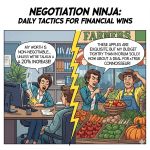
Let me tell you about my friends, Brenda and Kevin. They are a living, breathing, and frequently bickering case study in the psychological circus that is personal finance.
Last weekend, we all went to a fancy new burger joint. The kind where the menu describes the cow’s name, favorite grass field, and its astrological sign. Brenda, without so much as a blink, ordered the “Sir Loin-A-Lot Deluxe” for $28. It came with truffle-infused, air-fried, gold-dusted fries. Probably.
Kevin, meanwhile, spent seven minutes interrogating the poor, tattooed waiter on the ice-to-water ratio in the soft drinks ($4 with free refills) before ultimately deciding to just have tap water. “It’s the principle!” he hissed at Brenda, who was already Instagramming the artisan ketchup.
Later that same day, I witnessed Kevin, the man who just boycotted a $4 soda, absolutely obliterate his credit card on a website called “MythicBattles.com” for a rare, glow-in-the-dark elf wizard miniature. It cost $175.
“Whoa, Kev,” I said. “That’s a lot of principle.”
He looked at me, eyes gleaming with the fervor of a treasure hunter. “Dude, it’s not just a miniature. It’s Glimdor the Enlightened, first edition, pre-errata! It was a steal!”
Brenda just sighed, the sound of a woman who has long accepted that her husband’s brain has two separate bank accounts: one for things he values, and one for everything else.
This, my friends, is not logic. This is the psychology of money. It’s a messy, hilarious, and deeply human rollercoaster happening inside our skulls. So, grab your emotional popcorn and let’s take a ride through the cognitive biases, mental accounting errors, and emotional short circuits that explain why we save, splurge, and sometimes buy a glowing plastic elf.
Act I: The Tale of Two Brains (Or, Why Your Ancestors Are Ruining Your Budget)
To understand Kevin and Brenda, we have to meet the roommates living in your head. Let’s call them Caveperson Carl and Professor Penelope.
Carl is old. Really old. He’s got a unibrow, a club, and one job: keep you alive. He’s obsessed with immediate rewards and avoiding danger. He’s the part of your brain that sees a berry bush and thinks, “EAT ALL THE BERRIES NOW BEFORE A SABERTOOTH TIGER EATS YOU!”
Professor Penelope, on the other hand, is the sleek, modern part of your brain. She wears glasses, drinks lattes, and plans for the future. She’s the one who says, “Now, Carl, if we plant some of these berries, we can have a whole farm next season and maybe even develop agriculture.”
Most of our money problems start when Carl knocks Penelope unconscious and goes on a berry-eating rampage.

This is called hyperbolic discounting. It’s a fancy term for our tendency to choose smaller, immediate rewards over larger, later ones. Carl couldn’t care less about a comfortable retirement in 2060. He sees a “50% OFF ONE-DAY SALE!” and his brain screams, “REWARD! GET REWARD NOW! DOPAMINE HIT INCOMING!”
This is why we splurge. A shopping spree, a fancy dinner, a spontaneous vacation—it’s all Carl getting his immediate berry fix. Saving money, investing, or budgeting requires Professor Penelope to be in charge, calmly thinking about the future. But Carl is strong, and his club is persuasive.
The Story of the Marshmallow Test (Gone Wrong)

The classic example is the Stanford Marshmallow Experiment. Kids were offered one marshmallow now, or two if they could wait 15 minutes. The ones who waited did better in life later on. Cue millions of parents desperately trying to teach delayed gratification.
But let’s be real. As adults, our marshmallow test is way harder.
Imagine I offer you $50 right now or $100 in a year. A lot of people, if they’re honest, would take the $50. Now! A bird in the hand! But what if I offered you $50 now or $100 tomorrow? Suddenly, it’s easy to wait. The further away the reward, the less powerful it feels to Carl.
This is why saving for retirement is so hard. It’s a marshmallow you have to wait 40 years for. Carl is basically dead by then, in his mind. He’d rather have the smaller marshmallow now, which he translates as “a new gaming console.”
Kevin’s $4 soda standoff was Professor Penelope’s doing—a small, immediate act of control. But his $175 elf was all Carl. The immediate reward of owning Glimdor the Enlightened was so powerful, so dopamine-rich, that the future consequence of a credit card bill was a problem for “Future Kevin.” And everyone knows Future Kevin is a responsible guy who totally has his life together. Present Kevin, however, has an elf to buy.
Act II: The Theater of Mental Accounting (Or, Why Free Money Feels Fake)
Now, let’s talk about Brenda and her $28 burger. To understand her, we need to explore mental accounting, a concept coined by economist Richard Thaler. This is the wild tendency we have to put money in different imaginary buckets, each with its own rules.
Real, logical finance says: Money is money. A dollar in your pocket is the same as a dollar in your bank account, a dollar from a tax refund, or a dollar you found in an old coat.
Our brains say: HAHAHAHA, NO.
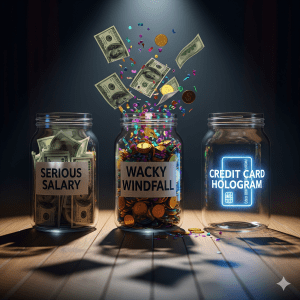
We treat money differently based on where it came from, where it’s stored, and what we plan to do with it. It’s like we’re running a internal theater production where every dollar bill is an actor playing a different role.
-
The Hard-Earned Salary: This money is serious. It’s played by a stern, Shakespearean actor. You think twice before spending it. It’s for bills, groceries, and responsible things.
-
The Windfall: Tax refunds, bonuses, birthday cash, found money. This money is played by a wacky clown. It’s “free money”! It must be spent immediately on fun, frivolous things! It doesn’t feel real, so it doesn’t spend real. Logically, a $1000 tax refund is just your own money being returned to you. But to your brain, it’s a surprise bonus, a mandate to splurge.
-
The Credit Card: This isn’t even a real actor; it’s a hologram. It feels like play money. Swiping a card doesn’t trigger the same pain as handing over cold, hard cash. This is why people spend more when using cards—Carl doesn’t feel the immediate loss of berries.
The Case of the Magical Vacation Fund
Brenda is a master of mental accounting. She wanted a vacation to Sicily. Professor Penelope said, “We should save systematically from our main account.” Carl said, “BERRIES!”
So, Brenda created a separate savings account labelled “SUN AND PASTA.” She started automatically transferring $200 a month into it. That money, once it entered the “SUN AND PASTA” account, ceased to be real money. It was no longer for bills or emergencies. It was vacation money. Its destiny was pre-ordained.
This is actually a good use of mental accounting. She was tricking Carl into saving by making the future reward (Sicily) feel more tangible.
But mental accounting has a dark side. Let’s go back to the burger. Why was a $28 burger okay?
Because they were “out for a nice dinner.” They had mentally allocated funds to the “Dining Out / Entertainment” account. The rules of this account are different from the “Groceries” account. Brenda would never spend $28 on ground beef at the supermarket. That would be insane! That’s from the “Groceries” account, which is managed by the stern Shakespearean actor. But in the “Entertainment” account, managed by the wacky clown, $28 for a single meal is perfectly reasonable. You’re not paying for beef; you’re paying for an experience.
Kevin’s failure was that he was trying to apply the rules of the “Groceries” account (where $4 for liquid is an outrage) to the “Entertainment” account. He was booing the clown for not being Shakespeare.
Act III: The Pain of Paying and The Power of Story (Or, Why That Elf Was a “Steal”)
Now, let’s dissect Kevin’s elf purchase. This involves two final concepts: the pain of paying and the endowment effect.
The Pain of Paying is exactly what it sounds like. Spending money hurts. It’s a literal psychological pain. Studies have shown that the same brain regions that light up when you experience physical pain also activate when you part with your cash.
But some things hurt more than others.
-
Paying with cash: Extreme pain. You feel the money leaving your hand.
-
Paying with a debit card: Moderate pain. You see the balance drop.
-
Paying with a credit card: Minimal pain. The pain is deferred, like a bill from a dentist who may or may not exist.
-
One-click online purchase with stored info: What pain? I feel only the joy of acquiring Glimdor!

Kevin bought his elf online. The pain was virtually zero. It was a seamless exchange of digital promise for digital glory.
But that’s not enough to justify $175. He needed a story. This is where the endowment effect and value attribution come in.
The endowment effect is our tendency to value things more highly simply because we own them. But it starts even before we own them. We fall in love with the story of an object.
To you and me, Glimdor the Enlightened is a piece of plastic. To Kevin, he is:
-
A rare artifact.
-
A key piece for his unbeatable gaming strategy.
-
A symbol of his expertise and status in the MythicBattles community.
-
A future heirloom that will surely appreciate in value.
He wasn’t buying plastic; he was buying that entire narrative. The story justified the price, turning a splurge into an “investment.” The $175 wasn’t a cost; it was an entry fee into a club of elite collectors. The pain of paying was anaesthetized by the powerful story.
Conversely, the $4 soda had no story. It was just… sugar water. A commodity. There was no narrative to justify the pain. It was pure, unjustified expense.
Curtain Call: How to Be the Director of Your Own Financial Play

So, what’s the takeaway? Are we all just helpless puppets being controlled by a caveperson and a professor? Well, yes. But knowing they exist is the first step to directing the play.
Here’s how to hack your money psychology:
-
Appease Carl, But Don’t Let Him Drive: Give Carl his berries. Use a budgeting system that has a “fun money” category. When Brenda and Kevin give every dollar a job, including a job for “Kevin’s ridiculous elves” and “Brenda’s fancy burgers,” there’s no guilt. Carl gets his immediate reward, and Professor Penelope remains in charge of the overall plan. They can splurge without derailing their finances.
-
Make Future Rewards Feel Real: Combat hyperbolic discounting by visualizing your goals. Don’t just save for “retirement.” Save for “a porch on a lake house where I can drink coffee and yell at clouds.” Put a picture of it on your fridge. Turn abstract future marshmallows into tangible, desirable ones that even Carl can get excited about.
-
Use Mental Accounting for Good, Not Evil: Create separate savings accounts for specific goals—”New Car,” “Emergency Fund,” “Sicily.” Name them! This makes the money feel dedicated and real, reducing the temptation to raid it for something else. But remember, it’s all the same money. Don’t let the “windfall” account clown trick you into thinking a tax refund is free money. It’s your money! Send it to a responsible account immediately.
-
Increase the Pain of Paying (Just a Little): If you’re a splurger, switch to cash for discretionary spending. Physically handing over $175 for an elf would have given Kevin a much-needed jolt of reality. The tangible pain might have made him question if the story was really worth it. At the very least, delete your saved credit card info from shopping sites. The extra steps to fetch your wallet create friction, giving Professor Penelope time to wake up and intervene.
-
Interrogate the Story: Before a big purchase, ask yourself: “Am I buying the object, or am I buying the story?” Is this $200 jacket genuinely warmer, or am I buying the story of being the kind of person who wears adventure-ready athleisurewear? There’s nothing wrong with buying a story—we all do it—but be honest about it. Make it a conscious choice, not a trick your brain is playing on you.
Money isn’t about math. It’s about emotions, biases, and the ancient, hilarious wiring of our brains. We are all just trying to make better choices while being periodically clubbed by a caveperson and soothed by a professor.
So, the next time you see someone happily paying $28 for a burger while scoffing at a $4 soda, or dropping $175 on a miniature elf, don’t judge. Just smile. They’re not being irrational. They’re just human. And their internal financial theater is putting on one heck of a show.