Last week, I was on a whirlwind trip across India, reconnecting with my roots. My wife and kids were there for summer vacation, and I took the opportunity to visit several major cities and small towns—essentially retracing my journey growing up. It was a deeply nostalgic experience, but one that sparked some honest self-reflection.
Now that I’m back in Dubai, easing back into my routine, I found myself reflecting on the choices I’ve made—particularly around money, careers, and life direction. And that’s where the theme of this post emerges: Consistency vs Adaptability.
The Two Sides of Growth
I’ve always been a curious mind, a passionate reader of self-improvement and personal finance books. I understand the magic of compounding and the principles of long-term investing. But despite having had many high-paying roles over the years, my net worth today is not where it could have been.
Why?
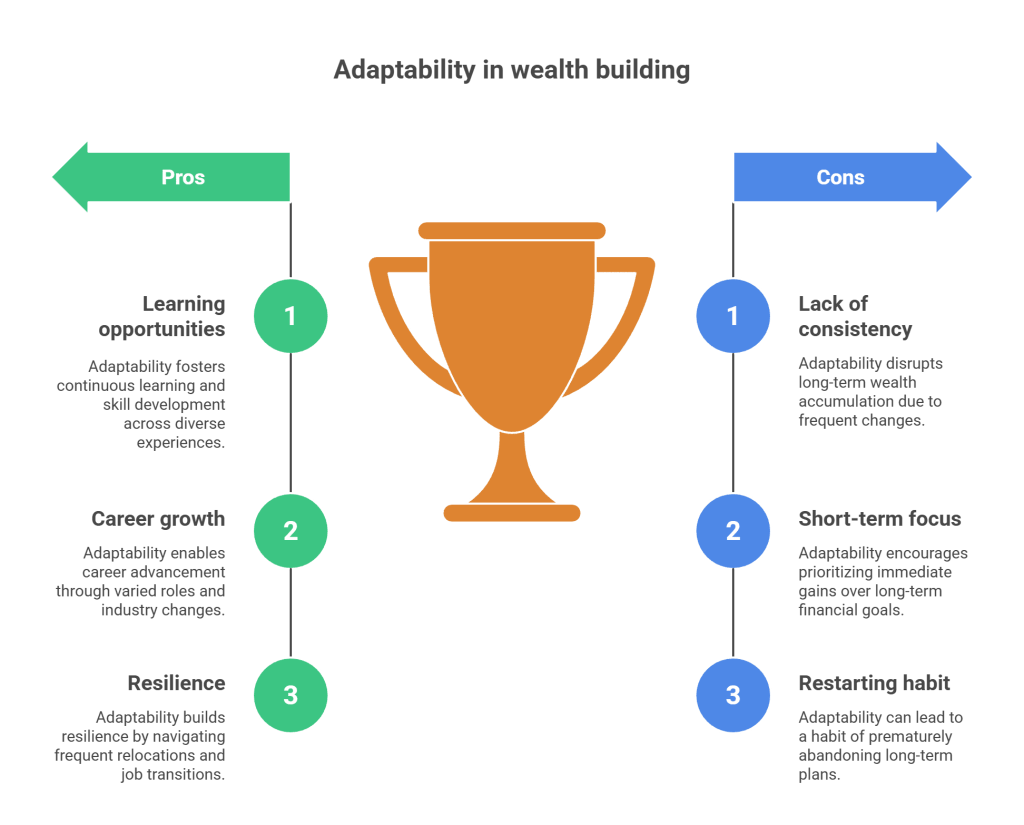
Because “life happened.” I relocated multiple times across countries. I changed industries. Switched jobs. Started from scratch over and over again. And while that adaptability allowed me to learn, explore, and evolve, it also meant sacrificing the biggest asset in wealth building: consistency.
Let me be clear—adaptability is a superpower. In today’s world, being agile, open to change, and able to pivot is vital. But too much adaptability can become a slippery slope. It can make us overly comfortable with the idea of restarting, of abandoning long-term plans prematurely, or making decisions based on short-term gains.
The High Cost of Restarting
Take, for instance, the financial cost of changing cities or careers. Sure, a new job might pay more. But factor in relocation costs, new living arrangements, temporary drops in income, and the emotional toll of change—and often, the gains are negated.
Worse, constant resets can fracture our financial rhythm. You stop investing consistently. You dip into your savings more than you should. You delay big financial decisions. Before you know it, you’ve wasted not just money, but time.
The Power of Consistency: Proven by Data
Numerous studies support the idea that consistency trumps intensity:
- A 2017 Vanguard study showed that investors who stayed the course with regular, automated investments outperformed those who tried to time the market.
- Morgan Housel, in his book The Psychology of Money, emphasizes that wealth is more about behaviour than income or intelligence. It’s about saving consistently, year after year.
- Warren Buffett didn’t become a billionaire overnight. In fact, over 90% of Buffett’s wealth was accumulated after the age of 50 – not because of risky moves, but because of the compounding power of consistent investing over decades.
The Sneaky Trap: Tying Money to Wants
One subtle but dangerous behaviour we often fall into is tying our savings goals to consumption. We save to buy a car. We save to go on a vacation. We save to upgrade our gadgets.
There’s nothing wrong with that—in fact, goal-based saving is great when you’re starting out. But if that remains your only saving motivation, you miss the bigger picture. You don’t build wealth for the sake of freedom, security, or opportunity.
And here’s the kicker: when real investment opportunities show up (like a market downturn), we don’t have the dry powder to take advantage.
The Law of Averages: Your Silent Ally
Instead of waiting for the perfect time or the perfect amount, just start small and stay steady.
For example:
- Pick an index fund (like one that tracks the S&P 500 or Nifty 50)
- Automate a small daily or weekly contribution
- Increase your investment by just 5-10% each year as your income grows
This is known as dollar-cost averaging, and it’s powerful. It allows you to buy more shares when prices are low and fewer when prices are high, effectively smoothing out market volatility over time.
Even investing $3/day (about the cost of a cup of coffee) can grow to over $70,000 in 20 years with average market returns.
Balancing Joy and Growth
Let me be clear: I’m not asking you to lead a joyless, minimalist life. In fact, I believe strongly in enjoying your money.
But the mindset shift that helped me was this:
- Save first, spend later.
- Even if you enjoy a good dinner out, a new gadget, or a spontaneous trip, you know your essentials and investments are already taken care of.
This eliminates guilt and leads to true enjoyment.

Looking Ahead: Resources I’ll Be Sharing
In the coming weeks, I’ll be sharing some of the funds I personally invest in—the ones that are simple, consistent, and perfect for beginners.
I’ll also be curating a list of books (with summaries) that have deeply influenced my mindset:
- The Psychology of Money by Morgan Housel
- Atomic Habits by James Clear
- The Millionaire Next Door by Thomas J. Stanley
These books aren’t just about money. They’re about mindset. And the right mindset is what fuels long-term discipline.
Final Thought
So here’s what I’ve come to realize: Consistency and Adaptability aren’t enemies. They’re partners.
- Adaptability helps you deal with change, seize new opportunities, and bounce back from setbacks.
- Consistency helps you build momentum, grow wealth, and create a strong foundation.
The trick is to adapt when needed but stay consistent where it counts.
Your savings, your values, your health, your routines—these are the areas where consistency brings the most return.
Everything else? Learn, pivot, and grow.
Let me know what you think in the comments below.
Have you faced the same tug-of-war between adaptability and consistency?
Until next time, stay curious, stay consistent, and always remember:
You are the captain of your life.