Most investors are leaving money on the table.
Some obsess over finding the next Tesla or Nvidia, pouring hours into stock analysis. Others cling to the safety of a cookie-cutter 60/40 portfolio, convinced that diversification alone will save them. The truth is, neither approach alone is enough.
Wealth isn’t built by picking a magic stock or by following a static allocation rule. It’s built through mastering two deeply interconnected disciplines:
- Asset Allocation – Your macro strategy. Deciding how much of your wealth belongs in stocks, bonds, real estate, alternatives, or cash.
- Capital Allocation – Your micro strategy. Deciding which specific stocks, bonds, funds, or projects get your dollars within each category.
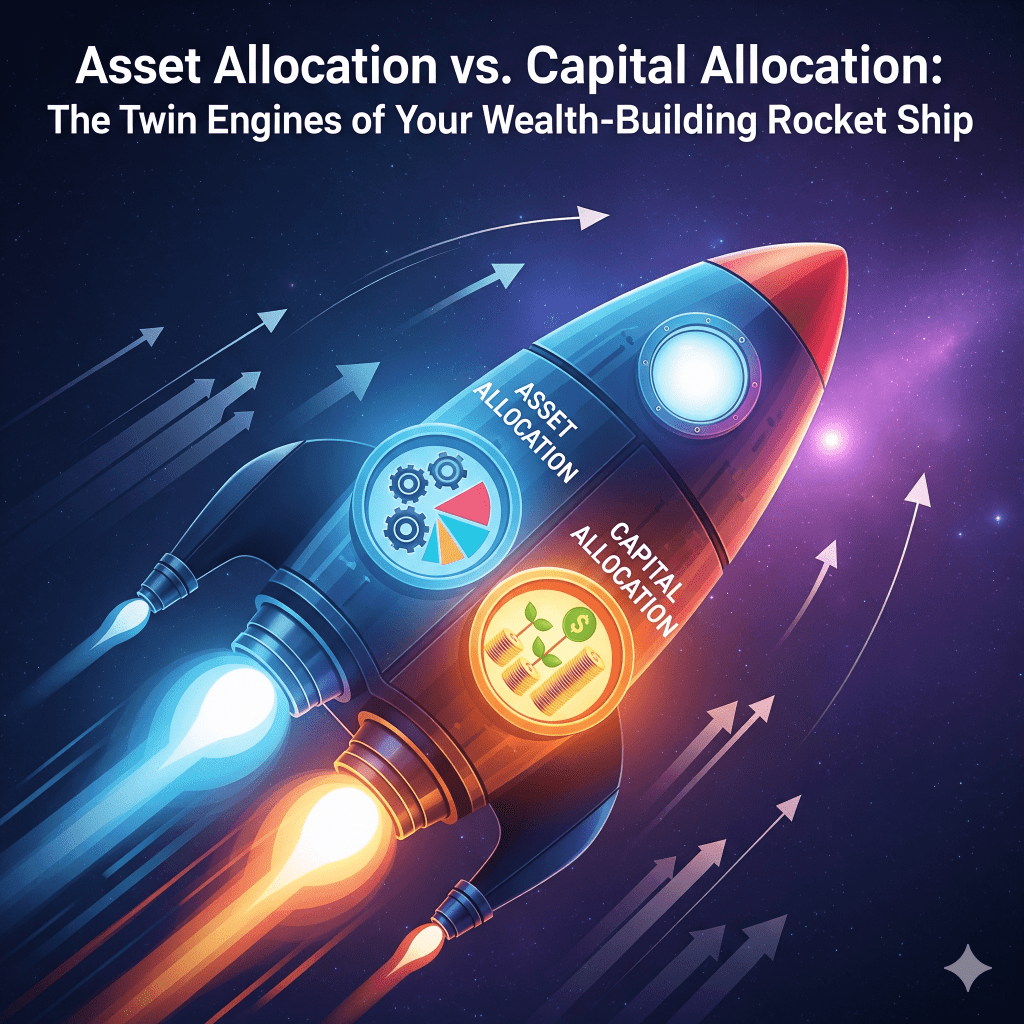
Think of your finances as a rocket ship. Asset allocation is the rocket design—its engines, structure, and fuel tanks. Capital allocation is the fuel—where and how you pour in resources to maximize lift-off. Miss either one, and you won’t get off the ground.
In this guide, we’ll unpack both strategies, draw lessons from history, add insights from legendary investors, and lay out a decade-by-decade roadmap for your financial life.
By the end, you’ll have a blueprint to think like a portfolio manager and a CEO of your own money.
Asset Allocation – The Big Picture
Imagine you’re a general preparing for war. You don’t send all your troops to one battlefront. You distribute them across the frontlines, reserves, logistics, and intelligence. Asset allocation is your war plan.
What is Asset Allocation?
It’s the high-level decision of how much of your total wealth goes into major categories like:
- Equities (Stocks) – High growth potential, high volatility.
- Examples: U.S. market ETFs like , Canadian ETFs like , global funds like .
- Fixed Income (Bonds) – Stability and income.
- Examples: , .
- Real Assets (Real Estate, Commodities, Infrastructure) – Inflation hedges and diversification.
- Examples: , gold ETFs like , energy funds like .
- Cash & Equivalents – Safety and liquidity.
- Examples: High-interest savings, money market funds, .
- Alternatives (Optional but growing) – Crypto, private equity, hedge funds, art.
- Examples: Bitcoin ETFs like , venture capital funds, tokenized real estate platforms.
Why Asset Allocation Matters More Than Stock Picking
Seminal research by Brinson, Hood, and Beebower (1986, 1991) showed that over 90% of portfolio returns come from asset allocation decisions—not stock picking or market timing.
Let’s look at the data over the past 30 years (1994–2023), covering booms, crashes, and pandemics:
| Portfolio Mix | Final Value of $10,000 | CAGR | Worst Drawdown |
|---|---|---|---|
| 100% S&P 500 | ~$200,000 | ~10.3% | -37% (2008) |
| 60/40 Balanced | ~$120,000 | ~8.5% | -20% (2008) |
| 100% Bonds | ~$60,000 | ~6.0% | -3% (2022) |
| Cash (T-Bills) | ~$22,000 | ~2.7% | None |
(Source: Portfolio Visualizer using Vanguard ETF proxies)
Key lesson: The 100% stock investor saw wild swings—amazing growth but gut-wrenching losses. The 60/40 investor built solid wealth with fewer sleepless nights. The all-bond or cash investors preserved capital but barely kept up with inflation.
Your chosen asset allocation sets the boundaries of your wealth journey.
Capital Allocation – The Art of Selection
Now imagine our general again. He’s decided to commit 60% of troops to the frontlines (stocks). But does he send elite commandos—or poorly trained recruits? That’s capital allocation.
What is Capital Allocation?
For companies, it’s how CEOs deploy capital: reinvest in R&D, buy back stock, pay dividends, or acquire competitors.
For individual investors, it’s the decision of which assets to own within each category.
- If you’ve allocated 30% of your portfolio to stocks:
- Bad capital allocation: Betting it all on a single meme stock.
- Good capital allocation: Splitting across , , and .
Why Capital Allocation Is Critical
Great asset allocation can be ruined by bad capital allocation. Consider:
- 2000 Dot-com Bubble: Investors who allocated to stocks but piled into Pets.com and Webvan lost nearly everything.
- 2008 Crisis: Those who diversified across value, growth, and international equities recovered faster than those who went all-in on bank stocks.
- 2020–21 Pandemic: A portfolio tilted entirely to airlines or cruise lines was crushed, while a diversified basket including tech thrived.
Howard Marks (Oaktree Capital) famously said: “Good investing is not necessarily about making great decisions. It’s about consistently not making bad ones.” Smart capital allocation minimizes those bad bets.
The Symbiosis
Think of your financial life as a sports team:
- Asset allocation is choosing which sport to play (soccer, basketball, chess).
- Capital allocation is choosing the best players for the team.
You need both. A basketball team made of amateurs loses to pros, even if basketball is the right sport. A team of elite sprinters can’t win a marathon if they’re in the wrong race.
Part 4: The Decade-by-Decade Roadmap
Your strategy changes as life changes. Here’s a blueprint by age (adjustable for personal risk).
Age 20–30: The Aggressive Accumulator

- Goal: Maximize growth—time is on your side.
- Suggested Allocation: 90% stocks, 10% bonds/cash.
- Capital Allocation Example:
- 70% U.S. broad market ()
- 20% international ()
- 10% bonds ()
- Key Action: Automate contributions—dollar-cost averaging beats market timing.
Age 30–40: The Strategic Builder

- Goal: Grow while managing new responsibilities (mortgage, kids).
- Suggested Allocation: 80% stocks, 15% bonds, 5% real assets.
- Capital Allocation Example:
- 60% U.S. (VTI, QQQ)
- 15% International (VXUS, emerging markets ETF)
- 15% Bonds (BND, corporate bonds)
- 5% REITs (VNQ)
- Key Action: Max out tax-advantaged accounts (RRSP/TFSA in Canada, 401k/IRA in U.S.).
Age 40–50: The Peak Accumulator

- Goal: Balance growth and safety.
- Suggested Allocation: 70% stocks, 25% bonds, 5% real assets.
- Capital Allocation Example:
- Add dividend ETFs (VYM, SCHD).
- Shift bond exposure to higher quality (treasuries vs. junk).
- Key Action: Rebalance annually—don’t let winners run unchecked.
Age 50–60: The Pre-Retirement Transition

- Goal: Preserve wealth, build income streams.
- Suggested Allocation: 50–60% stocks, 30–40% bonds, 5–10% cash.
- Capital Allocation Example:
- Tilt to dividend stocks (VYM, Canadian banks).
- Shorter-term bonds (VSBSX, GICs in Canada).
- 1–2 years of cash runway.
- Key Action: Stress test your retirement plan—simulate a 30% market crash.
Age 60+: Retirement & Distribution

- Goal: Generate income, outpace inflation, avoid sequence-of-return risk.
- Suggested Allocation: 40–50% stocks, 50–60% bonds/cash.
- Capital Allocation Example:
- Dividend stocks + REITs.
- Treasury Inflation-Protected Securities (TIPS).
- Annuities or structured products for guaranteed income.
- Key Action: Use a bucket strategy—cash for 2–3 years, bonds for medium term, stocks for long term.
Part 5: Modern Trends to Watch (2025 and Beyond)
Wealth-building strategies evolve. In 2025, these trends shape how you think about allocation:
- Rising Interest Rates: Bonds are attractive again after a decade of near-zero yields.
- Inflation Hedging: Commodities, infrastructure, and inflation-linked bonds are crucial.
- AI in Investing: Robo-advisors like Wealthsimple and Betterment now use AI-driven rebalancing.
- Global Diversification: Emerging markets (India, Vietnam, Africa) are projected to drive growth.
- Crypto as a Legitimate Asset Class: Bitcoin ETFs approved in U.S. and Canada make it easier to add a small allocation (1–5%).
- The ESG & Green Energy Shift: Renewable ETFs (ICLN, TAN) are gaining popularity.
Part 6: Action Plan – Be the CEO of Your Money
- Audit: What’s your current allocation? Write it down.
- Plan: Define your target allocation based on your age, risk tolerance, and goals.
- Execute: Use low-cost ETFs and index funds as the foundation. Sprinkle in alternatives if desired.
- Rebalance: Check annually. Trim winners, top up laggards.
- Adapt: Major life changes = allocation review.
Conclusion
Asset Allocation vs. Capital Allocation is not an either/or choice. They are the twin engines of wealth creation.
- Asset Allocation is your compass—what game you’re playing.
- Capital Allocation is your execution—who’s on your team.
As Jack Bogle said: “The enemy of a good plan is the dream of a perfect plan.” Don’t chase perfection. Build a resilient system, stay disciplined, and let compounding do its magic.
Your financial future isn’t built in one trade—it’s built through consistent, thoughtful allocation.
Further Reading: 5 Books to Deepen Your Understanding
If you’re ready to dive deeper into the world of asset allocation, capital allocation, and long-term wealth building, here are five excellent books available on Amazon.ca that expand on the ideas we’ve discussed:
1. The Intelligent Asset Allocator by William J. Bernstein
A classic that combines modern portfolio theory with practical strategies. It explains the “why” behind asset allocation and teaches you to maximize risk-adjusted returns.
2. The Art of Asset Allocation by David M. Darst
A practical deep dive into asset classes, investor behavior, and real-world frameworks for managing portfolios in different economic conditions.
3. Asset Allocation For Dummies by Dorianne Perrucci & Jerry A. Miccolis
An easy-to-follow guide that makes asset allocation simple, approachable, and beginner-friendly—without watering down the essentials.
4. The Investment Answer by Daniel C. Goldie & Gordon S. Murray
A short, powerful book that breaks down five key decisions every investor must make—including asset allocation and rebalancing—for a disciplined long-term strategy.
5. The Outsiders by William N. Thorndike Jr.
A brilliant exploration of eight unconventional CEOs who mastered capital allocation—proving that deploying resources wisely can create extraordinary value. Recommended by Warren Buffett.
The real question is: What’s the first change you’ll make today to align your money with your mission?
Disclaimer: This blog post is based on personal experiences and opinions and does not constitute professional advice. Please consult your financial, legal, or health advisor before making any decisions. Read our full Disclaimer.